UnaVoce              
 New Hampshire
Una Voce is an international federation of associations 
dedicated to preserving, restoring and promoting the Mass according to the 1962 Roman Missal of Blessed John XXIII
                           In Support of the Traditional Latin Mass


 **********************************
   1962 Missal Saints Feasts

       
        St. Raymond Nonatus
                 Pray for Us!


Aug. 29 -- Beheading of St. John the
               Baptist
Aug. 30 -- St. Rose of Lima, Virgin
               Sts. Felix and Adauctus, Martyrs
Aug. 31 -- St. Raymund Nonnatus, Confessor
Sep.   1 -- St. Giles, Abbot and
               Twelve Holy Brothers, Martyrs

Sep.   2 -- St. Stephen, Confessor
Sep.   3 -- St. Pius X, Pope and Confessor:
Sep.   5 -- St. Lawrence Justinian, Bishop and
                Confessor
Sep.   8 -- Nativity of the Blessed Virgin Mary
                and 'St. Hadrian, Martyr
Sep.   9 -- St. Gorgonius, Martyr
Schedule:
Next TLM's in NH/Northern MA:


Wednesday, Sept 1, 2010
St. Monica's Church       
Methuen, MA
Sung Low Mass                       7:00PM
Not Confirmed

Friday, September 3, 2010

St. James Church 
Lafayette Road, Portsmouth, NH
Low Mass                               12:10PM
Confirmed


Sunday, September
5
No Masses currently scheduled in NH


Sunday, September 12
St. James Church   
Lafayette Road, Portsmouth, NH
Low Mass with Hymns           12:30PM
Confirmed

St. Patrick Church   
Nashua, NH
Low Mass                                 1:30PM
Confirmed


14thSunday
         after
   Pentecost


Dear Friends:

If this is your first time visiting Una Voce NH, welcome. The Mission of Una Voce NH is to promote the spread of the offering of the Traditional Latin Mass(TLM) in New Hampshire. As the official voice of Una Voce International in New Hampshire, our goal is to unite traditional Catholics  throughout the state in a network to support and promote the celebration of the Mass according to the 1962 Missal of Blessed John XXIII. The TLM is now available in NH at four parishes  for  the first time in almost 40 years.

In neighboring Northern Massachusetts,
the TLM is also growing. We need your help. Volunteer your efforts or donate to our cause!!!

Thank you...and may God Bless you!!!

Bill St. Laurent
President,
Una Voce New Hampshire
Telephone    603-436-1378   

Billstl60@aol.com
 
 Support the Latin Mass in 
         New Hampshire   

Una Voce New Hampshire is registered with the state of New Hampshire as a charitable, independent nonprofit organization. The spread of the celebration of the traditional Latin Tridentine has created significant needs including: 
- communicating the message of the
  beauty and theology of the Latin Mass,
- enabling programs for Priestly formation
  in Latin in the traditional rite,
- training for Altar Servers, 
- development of sacred music programs,
-
and sacristal support and procurement of traditional vestments, altar cards, communion pattens etc.
We need your help. Volunteer
your efforts or donate to our cause!!!
Donations may be made to Una
Voce NH with checks payable to
same.

Please send donations to: 
     
Una Voce New Hampshire
Martin Cameron
Treasurer 
469 Ocean Road
Portsmouth NH 03801
Telephone 603-431-7977

mcame038@myfairpoint.net


The Beheading of John the Baptist
+++++++++++++++++++++++++++++++
Traditional Confirmations in London

— Fr. John Zuhlsdorf

I am happy to report that in London, at St. James Church, Spanish Place, confirmandi will receive the Sacrament of Confirmation in the older, traditional, Extraordinary Form of the Roman Rite at the hands of Bishop George Stack, auxiliary bishop of Westminster.

The rite will take place on 20 November 2010.

Contact them for information: info@latin-mass-society.org

++++++++++++ Breaking News ++++++++++++++
offers the Traditional Latin Mass at Sacred Heart Parish, 340 Centre St. Middleborough, MA.


We recently made mention of a video which was produced about the Benedictine Abbey of Fontgombault in France, and which aired on EWTN. Now it has come to our attention that the following video, "Living the Liturgy: Clear Creek Monastery", has also been made available through EWTN, this time about the daughter-house of Fontgombault, Clear Creek Abbey in Oklahoma.

While the video is 52 minutes in length, I would encourage you all to make the time to watch it at some point. The video is excellent and guides you through the monastic life and day, particularly through the lens of the sacred liturgy. (A thought strikes me as well: parishes, Catholic schools and other institutions which endeavour to have vocations related materials should try to ensure they have resources such as this video to also inform men and women about the possibilities of monastic life; an all too easily forgotten and neglected vocational consideration.)

To give you a taste, here a few screenshots showing some of the liturgical aspects within the video:


Former Ratzinger Students to Consider Vatican II


ROME, AUG. 26, 2010 (Zenit.org).- The Second Vatican Council and its implementation is the theme of this year's meeting of the "Ratzinger Schulerkreis," a group of the Pope's former students. Benedict XVI will participate in some of their discussions...

L'Osservatore Romano reported that the main speaker for this year's study weekend will be Archbishop Kurt Koch, the new president of the Pontifical Council for Promoting Christian Unity.

The Swiss prelate will give two lectures, one on "Vatican II Between Tradition and Innovation" and another on "Sacrosanctum concilium" and the reform of the liturgy.

[I am moving Matt's piece back to the top as there are some important themes within it that I think are important to highlight - SRT]


Examples of well-designed oriented altars with (left) a dossal and tester and (right) a ciborium (sometimes incorrectly called a baldachin)

The relationship between the tabernacle and the altar has, for the past two centuries, been one fraught with difficulties. The laity, particularly in America, frequently assume the elaborate wedding-cake altarpieces of the nineteenth century represent the fruits of some forgotten golden age; and indeed, they are not without their own charms, especially when compared with the Ikea modernism (and, unfortunately, occasionally Ikea classicism) that is the unique heritage of our own rather confused and cautious age. However, it is not without good reason that the rubricists of the Sacred Congregation of Rites and the enthusiasts of the twentieth-century Liturgical Movement, thought these highly interesting objects represented a sort of well-intentioned Eucharistic confusion. I do not say I agree with them per se, but read further.

At least one author has called the church of the nineteenth century a Eucharistic presence chamber, and not a true place of sacrifice--the reredos with its enormous and frequently unrubrical tabernacle overwhealming the little Great Aunt Esther's-style sideboard altar, an impression not improved on by overwhelming and badly-deployed flower displays. This can seem a rather peevish and petty response to the presence of God on earth, and perhaps such complaints sprang from the lips of oversensitive aesthetes and theological hair-splitters. Certainly we have gone to the opposite extreme since the Council, banishing the presence of God on earth to tiny broom-closet cenacles and reducing beautiful hand-carved retablos to liturgical backdrops, but at the same time, there is much to be said for such critiques. To simply reuse lightly-adapted nineteenth-century forms of liturgical planning is to solve a newish problem by returning to an older one and avoid the heart of the matter.

A number of old confusions have begun to re-surface, such as the claim that mass versus Deum is said thus so as to face the tabernacle. Mass is not an act of adoration of the Blessed Sacrament, but a propitiatory offering of It to the Father. (One is reminded of the strange habit of the Mariavite schismatics of requiring every mass to be coram Sanctissimo, which must have been very hard on the knees.) To claim otherwise reduces the unique beauty of Eucharistic adoration, Benediction, and our other acts of worship to Our Lord in the Host. There is room for both in our churches, but these theological distinctions are critical, lest the Trinitarian dimension of the Mass, and of Christ's role as mediator with the Father, be completely lost in the mind of the average Catholic. It is perfectly logical that we face the tabernacle during mass, of course, and it is the best solution to this complex liturgical issue, but historically it is not the sole or even principal reason for oriented worship.

Confusion over this complex relationship is particularly evident in instances where a new freestanding altar is retained, while the tabernacle is returned to its original location on the high altar, or even under a baldachin. This places the altar and tabernacle in competition, or perhaps even makes the tabernacle the central focus of the church to the exclusion of the altar. There is a reason, shortly before the Council, Pius XII thought it best that the tabernacle and altar ought not to be separated, precisely because it avoids this sort of quandary. I am by no means suggesting the tabernacle not be placed at the center and heart of our churches, but the altar must be placed there as well.

The later Liturgical Movement often urged the removal of the tabernacle to some other place in the church to restore the primitive purity of the altar, but by separating the two it seems to have merely confused people both about the role of the altar and the theology of the Real Presence. The wisdom of the rubricians is evident here: the altar is important liturgically; the tabernacle contains the most important Person on earth. Rather than seek to choose between the two, they simply brought them both together. Church restorations must weigh this relationship carefully, while remembering most parishes will still demand a freestanding altar with the tabernacle behind, rather than upon it, for pastoral reasons.

Some places will require a reredos behind a freestanding altar, which will be a natural place for the tabernacle. Some churches' sightlines absolutely demand it, and baldachins are comparatively more costly and can eat up valuable space in a small sanctuary. There is room for both ways in the Church. Indeed, I have designed one in the past (and seen it constructed) and I recently did some design work on another. There are ways to reproduce the old relationship in spirit, by creating a careful visual relationship between altar and reredos, ensuring the two work together rather than competing; some of this can be achieved by carefully watching the way space, and most importantly, floor levels, are defined within the chancel. The eye must also be drawn to the altar as well, and not simply up and over it. Careful use of color may also allow the freestanding altar to stand out against the reredos while retaining an integral relationship with it. A simple hanging tester over the altar may also be one possible solution, perhaps the best one; the reredos behind can serve as a sort of conduit between the two elements, altar and canopy. This may be the most ideal arrangement in many re-renovated churches, though where possible, the baldachin ought to be encouraged. In modernistic open-plan designs, it may give a sense of dynamism to low, centralized sanctuaries.

Clear mistakes, such as placing a tabernacle beneath a baldachin, and the altar some ways in front of it, rather lost and completely naked, should never be undertaken. I would much prefer a reredos as a tabernacle shrine with a freestanding altar than dump an altar in front of a gigantic baldachin covering only a tabernacle.

Attempts must be made, while allowing for the current liturgical climate, to bring the altar and tabernacle closer together spiritually, or even physically where possible, and find ways, through canopies and aedicules, to give appropriate honor to both. A nice balance of relative scales and placement--albeit one requiring some adaptation of its own--can be see in the image reproduced at the start of the article. (Of course, prudence should always be the first principle here: it is dangerous to mess with the Blessed Sacrament!)

As I said above, the wedding-cake catalog-bought reredos of most nineteenth-century churches has serious deficiencies from both a rubrical and theological perspective. First, most tabernacles of the period were not truly tabernacles, but sort of Eucharistic pigeonholes reminiscent of aumbries or sacrament-houses. Sometimes they may be the best choice for an interior, but a choice for them must be made knowing all the rubrical issues they bring up. There is a place for both of these in the tradition of the Church, and I don't object to their re-use, as they are often rather charming, but they do not represent the pure, rubrical, Roman tabernacle. This is a freestanding object capable of being placed on an altar or gradine shelf, usually cylindrical, and capable of being veiled on all sides. The tabernacle ought not to have a permanent Benediction throne on top of it (though a temporary one was deemed appropriate), nor be used as the base of a statue. A crucifix is best placed behind it, in line with the altarpiece's six candlesticks.

Such prescripts are no longer strictly-speaking required by law (in particular, the veil, which in some documents is considered optional though laudable; though there are some footnotes in the General Instruction that imply these practices have some degree of importance still) but nonetheless represent an important refinement of the tradition.

Reredoses, of the proper shape and emphasis, are an ornament to any church, especially smaller ones that cannot afford a ciborium. Simply pushing an altar up against a wall, adding a crucifix, tabernacle, candlesticks and a sufficiently nice dossal can change a whitewashed barn into God's temple on earth. But for the time being, the freestanding altar under the ciborium (or hanging tester), with the tabernacle somewhere behind, remains the best possible arrangement in parishes where both liturgy versus Deum and versus populum are likely to remain the norm, lest we compound new mistakes with older difficulties.


   Large crowd fills Chapel for Manchester
        TLM at Precious Blood Monastery

Una Voce NH - A large crowd filled the Precious Blood Monastery Chapel last Sunday, August 15 for the Feast of the Assumption and witnessed a Sung High Missa Cantata offered by Fr. Adrien Longchamps. Father has begun offering the TLM at Precious Blood once a month.
Deo Gratias !!
Thank you Fr. Longchamps for pioneering the first regular TLM in Manchester.


        Jurassic  Park Liberal Priest

                    — Fr. John Zuhlsdorf

I could add a great deal more, and in rather strong language, to the observations made already over at Creative Minority Report.

When you watch this through, I think you will pretty much conclude that this old feller is perhaps less of heretic than he is of being not a very bright old liberal.

Wow. This is truly unbelievable. (The video has been pulled from the Parish Website, look below)

This is a video by the Rev. Joseph Patrick Breen, pastor of St. Edward’s Catholic Church in Nashville TN. This video is posted by the pastor on the parish website.


      Bishop Resigns
By KATHRYN MARCHOCKI
New Hampshire Union Leader Staff

MANCHESTER – Bishop John B. McCormack's resignation as leader of the Catholic Diocese of Manchester sets in motion the highly secretive, often long process by which the Pope and top church officials search for a successor.

McCormack mailed his letter of resignation to Pope Benedict XVI prior to turning 75 today, diocesan spokesman Kevin J. Donovan said yesterday.

Church law requires bishops, archbishops and cardinals to tender their resignation to the Pope by their 75th birthday. It is up to the Pope to accept their resignations and to appoint a successor.

McCormack is vacationing in another New England state with family and friends this week and was not available for comment, Donovan said. He is due back Monday.

Cardinal Bernard F. Law, then archbishop of Boston, installed McCormack as the ninth bishop of Manchester on Sept. 22, 1998.

The Winthrop, Mass., native previously was an auxiliary bishop in the Archdiocese of Boston and also served as one of Law's top aides, charged with handling priests accused of sexually preying on children and clerical misconduct.

The process for selecting a bishop is cloaked in secrecy and can take at least six to eight months, according to the U.S. Conference of Catholic Bishops.

The apostolic nuncio, who is the Pope's representative to the church in the United States and serves as the Vatican's ambassador to the U.S., plays a key role in the selection of a bishop.

McCormack has not prepared a report detailing the conditions and needs of the diocese because the apostolic nuncio has not requested one at this time, Donovan said.

Several church experts would not speculate on a possible successor, but have said it is likely the next bishop will come from outside the diocese.

Only two of the nine bishops appointed to head the Manchester diocese in its 125-year history were New Hampshire natives.

The diocese encompasses the entire state and has an estimated 310,000 Catholics.

This is the first time in the diocese's history that a bishop submitted his retirement letter when he turned 75, Donovan said.

Six bishops died in office. The late Bishop Ernest J. Primeau became the first to retire from office in 1974 at 64. Bishop Odore J. Gendron retired in 1990 at 69.

"We are all going to be learning together because this is the first time in recent memory that a bishop has submitted his retirement letter," Donovan said. "It's very exciting for us."

Already six American bishops, archbishops and cardinals have submitted their resignations when they turned 75, but the Pope has yet to accept them, said Don Clemmer, a spokesman for the U.S. Conference of Catholic Bishops in Washington. McCormack is the seventh. In addition, there are three dioceses and one Eastern Catholic eparchy that are vacant because they do not have a bishop, he said.

"Since the beginning of 2010, the U.S. church has seen over a dozen bishop appointments, including two new ordinaries in Texas alone, two in Pennsylvania, a new archbishop of Miami, coadjutors in Trenton and Los Angeles, and a handful of auxiliaries. You could make the argument that this has been an eventful year," Clemmer said.

A Contrast: Recessionals from Catholic Masses


Sprint Arena, National Catholic Youth Conference Mass, 2009. Kansas City


Assumption Parish Mass, 2009, Syracuse, NY

   
St. John Cantius Church, 2008, Chicago, IL


              Solemnity of the Assumption


I get emails every day about EF Masses popping up around the country - certainly more than I can keep up with. The latest comes from St. Benedict's Catholic Church in Duluth, Minnesota.

St. Benedict's will celebrate the Extraordinary Form 1:00pm as a high Mass with Incense to the polyphonic setting - Missa Pange Lingua by Des Prez. This celebration of the Solemnity of the Assumption of the Blessed Virgin Mary will feature a mixed chorus of men and women raising their voices in polyphony.

The above photo was taken just this week. This looks like a typical 1960s church in the round. Rev. Hastings reports:
The Triptych depicting the Last Supper, the Crucifixion, and the Resurrection evoking the Ascension in the style of Raphael - imaging the Paschal Mystery made present in the bloodless Sacrifice of the Mass.

Hastings offers as well these earlier photos of the same sanctuary as it underwent transformation.
Use of color to help a drab space during Advent.


Beginning of the Pope Benedict altar crucifix/cross to begin reorientation of the liturgy ad Deum/ad orientem/ad apsidem.


All the Masses at St. Benedict's parish (with the exception of the early Sunday morning Mass) are celebrated in the common posture turned towards the Lord (ad orientem) in the direcetion of the liturgical east. The Extraordinary Form of the Roman Rite is offered on the 1st & 3rd Sundays at 1 PM. The other Masses are offered in the Ordinary Form with an increasing use of chant (vernacular plainchant and simpler forms of Gregorian chant) for the ordinary and some antiphons.

  Cardinal Burke: Novus Ordo reforms are
     not to be introduced into TLM Liturgy
No Altar girls or Lay Eucharistic ministers permitted in Extraordinary Form


For a while now, a German Canonical Commentary on Summorum Pontificum by the German latinist and canon lawyer Fr. Gero P. Weishaupt (whom we mentioned here and here) has been available online (link). This commentary has now been published as a book, and the preface to this book was written by H.E. Archbishop Raimond L. Burke, Prefect of the Apostolic Signatura. The full text of the preface is available at the German website Summorum Pontificum (link). Here is an NLM translation of a passage of the preface which doubtlessly will raise great interest:

In the second chapter of his commentary, Weishaupt answers a number of practical issues that arise regarding the implementation of Summorum Pontificum and result from recent changes to the discipline of the celebration of the sacraments, such as e.g. those regarding female altar servers or lay people who perform the ministry of lectors or extraordinary ministers of Holy Communion. To answer these questions , the commentary correctly applies two general canonical principles.

The first principle requires that liturgical norms, which were in force in 1962, are to be diligently observed for the celebration of the Extraordinary Form of the Roman Rite, for these norms protect the integrity of the Roman rite as contained in the Missal of Blessed John XXIII. The second principle states that the subsequent liturgical discipline is only to be introduced in the Extraordinary Form, if this discipline affects a right of the faithful, which follows directly from the sacrament of baptism and serves the eternal salvation of their souls.

The application of these two principles to the cases mentioned leads to the conclusion that neither the service at the altar by persons of the female sex nor the exercise of the lay ministries of lector or extraordinary minister of Holy Communion belong to the basic rights of the baptized. Therefore, these recent developments, out of respect for the integrity of the liturgical discipline as contained in the Missale Romanum of 1962, are not to be introduced into the Extraordinary Form of the Roman rite. The commentary presents here in an impressive manner that the mutual enrichment of both forms of the Roman rite is only possible if discipline peculiar to each of the two forms is accordingly carefully observed.

ne of our Australian readers sent in news yesterday of their liturgical efforts in the diocese of Maitland-Newcastle. There, "a group of young dedicated laity has set about making the Extraordinary Form Mass available on a more regular basis" with the assistance of a parish priest who has granted access to his parish for the celebration of the usus antiquior.


St Patrick's, Wallsend Australia offers first TLM

The parish in question is St. Patrick's, Wallsend and this past Sunday, they celebrated their first Missa Cantata, celebrated by Father Terence Mary Naughtin OFM Conv.


The community notes the following:

Extraordinary Form Masses are offered on many Sundays at St Patrick's Catholic Church, Macquarie Street, Wallsend at either 11.30am or 3.30pm. Those living in the area are strongly encouraged to attend and support this new Extraordinary Form apostolate and others are kindly asked to support us with their prayer. Further information on exactly when Masses are held can be obtained by emailing newcastle-latin-mass@catholic.org


  Precious Blood Monastery, Manchester  
     TLM to be held Sunday August 15
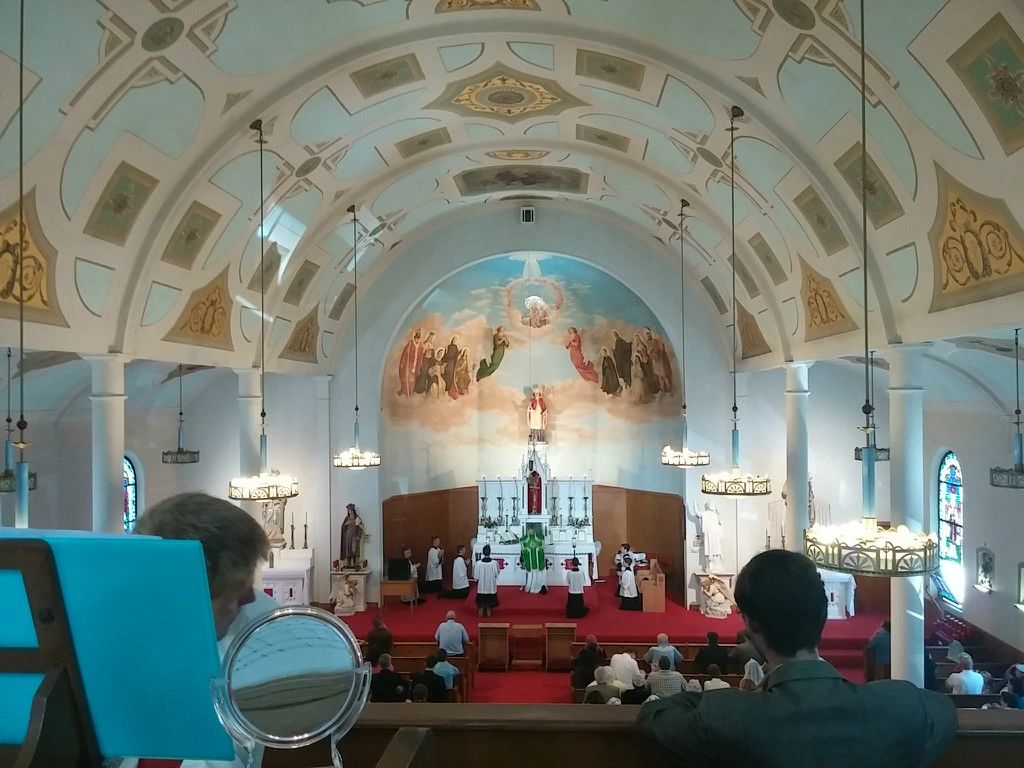
(Una Voce NH) -  As we announced, Fr. Adrien Longchamps will offer the traditional Latin High Mass on Sunday, August 15th at 10 AM at Precious Blood Monastery in Manchester. The Monastery and Chapel are conveniently located at 700 Bridge Street in Manchester. The Chapel is beautiful including a full traditional High Altar for offering the TLM.
Telephone is 603-623-4264.


Reminder: On August 15, the Tridentine
Solemn High Mass moves from Noon to 10:30AM 

     Photos from Solemn High Masses at Mary
          Immaculate of Lourdes, Newton, MA 

(Una Voce NH) - Previously we announced that Mary Immaculate of Lourdes in Newton, MA had begun offering the Solemn High Mass last Fall. Below are pictures from selected liturgies since that time.
Note the Tridentine Latin Mass moves from Noon to 10:30AM effective August 15, 2010.
Advent 2009
IMGP3790 by Mary Immaculate of Lourdes Newton.


IMGP3842 by Mary Immaculate of Lourdes Newton.

Palm Sunday 2010
IMGP5197 by Mary Immaculate of Lourdes Newton.
 
Maundy Thursday 2010
IMGP5536 by Mary Immaculate of Lourdes Newton.

IMGP5584 by Mary Immaculate of Lourdes Newton.

Easter Vigil 2010
_IMG5806 by Mary Immaculate of Lourdes Newton.

Birettiquette, Revisited

- Fr. John Zuhlsdorf

And now for the really important things.

From a reader:

Dear Father,
Can you point me (or ask your readers to help to point me) in the direction of a guide to the use of the biretta at Mass in the Ordinary Form?  There’s much written about  the EF but I can’t find anything the GIRM, Elliott or the Ceremoniale which makes comment on the proper use.  Some have said that, in the new rite, clergy in choir should wear it during the Entrance procession unlike the EF rules.  I’m confused…

I think you should simply use it as it is used in the Extraordinary Form.

Once upon a time I actually had made a little pamphlet on this… but I can’t find it.  I will have to redo it in my copious free time.

In the military people need to know what to do with their hats, when to cover and uncover.  This varies with the services.  The Navy handles their covers differently than the Army, for example, when it comes to indoors and outdoors.

The same goes for clergy in choir dress.

Here are some rapid notes I sent to a priest friend who was going to be attending a TLM in choro for the first time and wanted to know what to do.  I think this applies to the Ordinary Form.

  • Carry the biretta in procession.
  • Only the sacred ministers wear it when walking.
  • Wear it when seated.
  • Remove it BEFORE standing and recover only when seated again.
  • Do not wear it kneeling.
  • Uncover at the Holy Name by removing the biretta and lowering it to your right knee.
  • Tip it in return if ministers bow to your direction as they pass before you or if they are heading to point X across the sanctuary and make the usual honorific bows.
  • When wearing the biretta in choir, it is removed at any point where one would bow the head, i.e. at the Holy Name, or when all three Persons of the Trinity are mentioned together. It should also be removed at the name of the Blessed Virgin and of the Saint of the Day or Titular.
  • Preachers can wear the biretta when preaching.
  • Put it on correctly!  If it is a three-horned biretta, what Italians call a "tricorno", the middle "horn" goes to the right side of your head so you remove and cover using your right hand. 
  • Servers should always offer the biretta so that the priest can grasp that middle "horn".
  • When standing, hold the biretta with hands before your chest, using both hands, holding the bottom edge so that the biretta is above your hands.
  • If in procession you are carrying a book, hold the book upright with the pages to the left and hook the top of the biretta in your lower fingers below the book.
  • Hold the biretta before your chest as described above when standing when orations are sung, the Gospel is sung, you are being incensed, the blessing at the end, etc.
  • Do not…not… sit on it!
There are some fast tips for your birettiquette!

Manchester/Suncook TLM's announced

for Sunday August 1 and August 15
(Una Voce NH) -  Fr. Adrien Longchamps has announced that he will offer the traditional Latin High Mass this Sunday, August 1st 11:30 AM  at St. John the Baptist Church in Suncook NH.  In addition, he will offer the TLM on Sunday, August 15th at 10 AM at Precious Blood Monastery in Manchester.


As a result of this new schedule, traditional Catholics in the Manchester/Nashua/Salem corridor now have access to the Traditional Latin Mass every Sunday except 5th Sundays. These Masses are on the 1st and 3rd Sunday and St. Patrick's, Nashua on the 2nd and 4th Sundays. Deo Gratias!! 

New President of the Pontificial Council for Christian Unity: Ad Orientum and Latin       

  — Fr. John Zuhlsdorf 

Our friends at Rorate have posted an excerpt of an interview with Archbp. Kurt Koch the new President of the Pont. Council for Christian Unity.  Here is an excerpt of the excerpt, originally with Gaudium Press in Spanish.

Gaudium Press: These two views [of the Church as People of God and as Mystery] also influence one’s position on the liturgy. How should the liturgy be understood today?

Archbp Koch:
All those things that some people say that was new after the Second Vatican Council were not a theme of the Constitution on the Liturgy [Sacrosanctum Concilium]. For instance, celebrating the Eucharist facing the faithful was never an object of Tradition. The Tradition had always meant celebrating facing East, because that was the position of the resurrection. In Saint Peter’s Basilica, the celebration took place facing the people for a long time because that was the direction facing East. The second thing was the vernacular language. The Council wished that Latin remain the language of the liturgy.

 WDTPRS kudos to Archbp. Koch.


Let the "New Evangelization" begin!


    Tradition Returns to Warren, MA
(Una Voce America) - For the past year, the Catholic faithful in Warren, Massachusetts have been able to attend the traditional Latin Mass every Sunday morning at St. Paul the Apostle Parish. The pastor at St. Paul’s, Fr. Daniel Becker, has spent nearly 10 years restoring the interior of this beautiful church. Meanwhile, the parish has also launched a traditional Catholic school for grades K-12. To learn more about the good news in Warren, please visit the parish website.
Article on return of the TLM to St. Paul's Warren, MA
Written by Teri Breguet   

      WARREN – The Traditional Latin Mass is offered every Sunday at 10:30 a.m. at St. Paul Church here. Father Daniel Becker, pastor, decided to bring the ancient Mass form back to his parish community after Pope Benedict XVI’s Motu Proprio in 2007, which granted permission for every priest to celebrate the Tridentine Mass, also called the Extraordinary Form of the Mass.

     Father Becker traveled to Chicago for training and received permission from Worcester Bishop Robert McManus before instituting the Latin Mass at St. Paul Church about one year ago.

    “As a priest it’s really tremendous because the prayers and the gestures and the movements lend themselves much more to greater reverence and a greater appreciation of the Mass,” explained Father Becker. “There’s more silence and everything is directed toward God as opposed to ourselves so there’s much more of a vertical component, if you will. It’s very clear and obvious especially to the priest. There’s less of an emphasis of the priest as a performer or the center of attention. It’s much more centered on the great high priest, our Lord Jesus.”

    Father Becker is amazed at the parish’s response. Before he offered the Tridentine Mass, it was always a struggle to find altar boys. “About one dozen boys signed up. In fact, we have to have a schedule now so that everyone gets a turn. The choir has also grown considerably. Every week we have choir rehearsal and it’s not uncommon to get a few dozen at rehearsal and sometimes as many as 30 in the choir.”

   
The local Knights of Columbus have donated a full set of new vestments for Father Becker in every liturgical color as well.

    The feedback from the congregation has been very positive.

    “It is quite a change from what we’re used to, and so, not surprisingly, there are some who have trouble going back to what the church used to have. And other people have embraced it wholeheartedly. Some people have said they’ve grown to love it more. It does take a lot more work at this Mass – all the richness of it and also the different language, the church’s language of Latin. So some people have said they started off and it was very difficult but over the weeks they’ve gotten used to it and they appreciate its beauty.”

    The Latin Mass is also offered once during the week at 8:30 a.m.

    St. Paul Church is located at 1060 Main Street in downtown Warren.


   Spanish Bishop offers TLM Requiem Funeral
   

This Wednesday, 28 July, the Archbishop of Saragossa, H.E. Msgr. Manuel Ureña Pastor, proceeded to reinter the remains of the family of the counts of Aranda, which had been resting in the parish church of Epila since 1745 and had to be moved during a recent restoration. Msgr. Ureña celebrated the burial according to the usus antiquior rituale in Latin. This is significant insofar as Msgr. Ureña is thus the first Spanish bishop to publicly use the usus antiquior books in Spain since the promulgation of the motu proprio Summorum Pontificum. The parish of Epila was featured before on the NLM, cf. here.


    Traditional Benedictine Nuns in France
           sign major recording contract!

— Fr. John Zuhlsdorf

It is hard to resist this story in the Independent.

What the story does not report is that these are the very traditional Benedictines of the Abbey of Sainte-Madeleine who are associated with the monks of Le Barroux on the next hill over.  My old chief and mentor, the late Augustine Card. Mayer, OSB, consecrated their first abbess.  They use only the old office and Mass and their vocations are through the roof.

Secluded order of nuns signs record deal behind closed doors [They missed the chance to say "behind bars".]

Members of an order of nuns so secluded they are rarely seen in the outside world have found a new vocation as recording artists with the record label of Lady Gaga, Amy Winehouse and Eminem.

The Benedictine nuns of
Abbaye Notre-Dame de l’Annonciation, near Avignon, France, signed a "major deal" for an album of their songs, and did so in a fittingly modest fashion. Since no visitors are permitted to enter the convent, the sisters had to be passed the contract through a grille, through which they posted it back signed.

[...]

The nuns’ new career originated in Decca’s search to find
the world’s best female singers of Gregorian chant after a company executive was charmed by an old recording he discovered of nuns singing. The Avignon nuns, who sing together eight times a day, beat off competition from more than 70 convents worldwide. Tim Lewis, head of A&R at Decca, said: "When you hear them chanting, it’s like an immediate escape from the stresses, noise and pace of modern living." [I have written many times on this blog that I find Gregorian Chant sung well by women to be absolutely transporting.]

The album, called Voice:
Chant from Avignon, will be released on 8 November. The nuns, who have no access to newspapers, TV or radio, now have their own Facebook page and feature in several YouTube videos.

Decca is hoping to repeat the success found when it signed the Cistercian monks of Heiligenkreuz Abbey, Austria, in 2008. The monks, who won the deal to record an album after uploading a video of their singing to YouTube, sold a million copies of Chant: Music for Paradise.


Singing monks and nuns are nothing new – in the Sixties a Belgian nun known as Soeur Sourire (Sister Smile) found international fame with her single "Dominique", and a group of Spanish Benedictine monks sold 16m copies of their album Chant in the 1990s.

You need to a flashplayer enabled browser to view this YouTube video


I hope these sister make millions.

See the Benedictine Sisters at Gloria TV by cutting and pasting the link below into your browser.

http://www.gloria.tv/?media=89998

Protect the Pope.com

  — Fr. John Zuhlsdorf 


Protect the Pope.com is a new website which counters attacks on Pope Benedict’s reputation and integrity, and provides information and resources for Catholics to respond to incidents that constitute incitement to religious hatred.

At the launch of Protect the Pope.com Rev Nick Donnelly, a permanent deacon of Lancaster Diocese who set up the site, said:
‘Its been said that anti-Catholicism is the last acceptable prejudice, and in a way we Catholics have colluded in this by ignoring it, hoping it will go away. But the personal attacks on Pope Benedict in the run up to the Papal visit show us its not going away.

Since 2006 we’ve had the legal right to protect ourselves from religious hatred. Of course people in this country have freedom of expression, but this does not mean they have the right to create a climate of hostility and fear. It’s a question of protecting our human rights to freedom of belief and freedom of worship.’
The website gives information on the law regarding hate crime and provides Catholics with the means to report to the police incitement to religious hatred or acts of religious hatred which take place during the Holy Father’s visit. The website also has an anti-Catholicism log tied into its news feed to help raise awareness of anti-Catholic prejudice.


And don’t forget your

“Pray for the Pope!” stuff


        Fitchburg moves to new Church
(Una Voce NH) - The closing of Immaculate Conception Church in Fitchburgh has resulted in the relocation of the Traditional Latin Mass there. The Latin Mass Fitchburgh Blog reports the following:

The Latin Mass Community expresses our most sincere thanks to the Right Reverend Bishop McManus for his help in our transition into a new parish home. Father Richard Trainor, pastor of Saint Joseph Church in Fitchburg, has extended a generous invitation to Father David Phillipson and the Latin Mass Community to have the Ancient Mass on a regular basis, including Holy Days according to the Traditional Calendar. The community accepts his invitation with sincere gratitude.

The Extraordinary Form of the Latin Rite will be offered every Sunday at 12:30PM as a Sung High Mass, beginning on July 4. The church is located at 49 Woodland Street in Fitchburg. All those attending are asked to please wait for the church to clear from the previous Mass before entering. Deo Gratias.


Benediction and Litany after the first TL Mass at St. Joseph's Church, July 4, 2010

Fitchburgh Latin Mass Blog address:
http://latinmassfitchburg.blogspot.com/


       The Scapular of Our Lady of Mount Carmel
       The Devotion to the Brown Scapular 
        Source: The Catholic Encyclopedia Best Brown Scapular 

Una Voce NH - The Scapular of Our Lady of Mount Carmel, also known as the Brown Scapular, this is the best known, most celebrated, and most widespread of the small scapulars. It is spoken of as "the Scapular", and the "feast of the Scapular" is that of Our Lady of Mount Carmel on 16 July. It is probably the oldest scapular and served as the prototype of the others. According to a pious tradition the Blessed Virgin appeared to St. Simon Stock at Cambridge, England, on Sunday, 16 July, 1251. In answer to his appeal for help for his oppressed order, she appeared to him with a scapular in her hand and said: "Take, beloved son this scapular of thy order as a badge of my confraternity and for thee and all Carmelites a special sign of grace; whoever dies in this garment, will not suffer everlasting fire

 (See full article in News/Links TLM Section on our site) 

Growing Latin Mass Community in 


Web Hosting Companies